
Quiet Selflessness Still Lives With This Vietnam Veteran
By Maureen ‘Mo’ McFadden
The following is an interview with John Selberg, Vietnam Veteran and former Santa Barbara resident, who agreed to talk with me. His was an unexpected story to find. And it all started in a planning meeting for The Moving Wall back in 2016.
John attended San Roque Catholic School and San Marcos High School graduating class of 1967. He and his family moved up to Santa Barbara from the L.A. area when he was in 4th grade. Michael, who passed away a few years ago, was the oldest followed by John, Tom, Jim, Chris and David. They settled in the Hidden Valley area. He and his wife, Betty, live in Albuquerque, New Mexico now.
John Selberg, a Vietnam Veteran, had never talked about the war since he got home in 1969. Forty-seven years later, he opened up a little and the conversation unfolds below.
Vietnam Veterans Local Chapter 218 had The Moving Wall on exhibition at Chase Palm Park in 2016 for six-days and the story of John meeting his brother Michael in Vietnam by complete chance is what spurred my interest in talking with him. The coincidence of his brothers meeting in DaNang came up in a planning meeting before The Moving Wall’s installation. VVA 218 was talking to John’s youngest brother, David Selberg, who heads up Hospice SB. We needed docents at The Moving Wall who could manage the emotions of those who would be visiting.
As I was prepping to start the interview, John said, “What you’re doing is a tremendous service to our Vietnam Veterans. We were not liked.” I thanked him for his service and I was honored to have his trust. Promised I would take good care of his words.
John’s wife, Betty was sitting next to him throughout the phone interview and chimed in a couple of times. She is whom David credits with being a strong and steady force that was a key component in John’s life.
When I asked John for permission to submit the story to print outlets elsewhere… he said, “Okay, but I don’t want the focus to be on me. Just say I served in Vietnam as a crew chief and I have nothing but admiration and respect for the people on that Wall — if people want to remember Vietnam Veterans — then remember especially those who are on The Wall… and those who were critically injured and are still laid up and suffering in hospitals today. I saw some gravely injured soldiers in the back of my helicopter who lived – I couldn’t do that. What people are given ‘on their chest’ is nothing compared to those whose names are on The Wall.”
At the VVA 218’s Dedication Ceremony for The Moving Wall, I told John members of the Chapter would be reciting the 99 names out loud of those brave men who lost their lives in Vietnam who were from Santa Barbara County. John liked that and added, “Anything I did – it’s in the past and I’m living with it physically and mentally — the brave men and women on the Wall – that’s who are important to remember… when they died, they gave it all, and their loved ones, parents, family and friends suffered tremendously. I came home. They did not.”
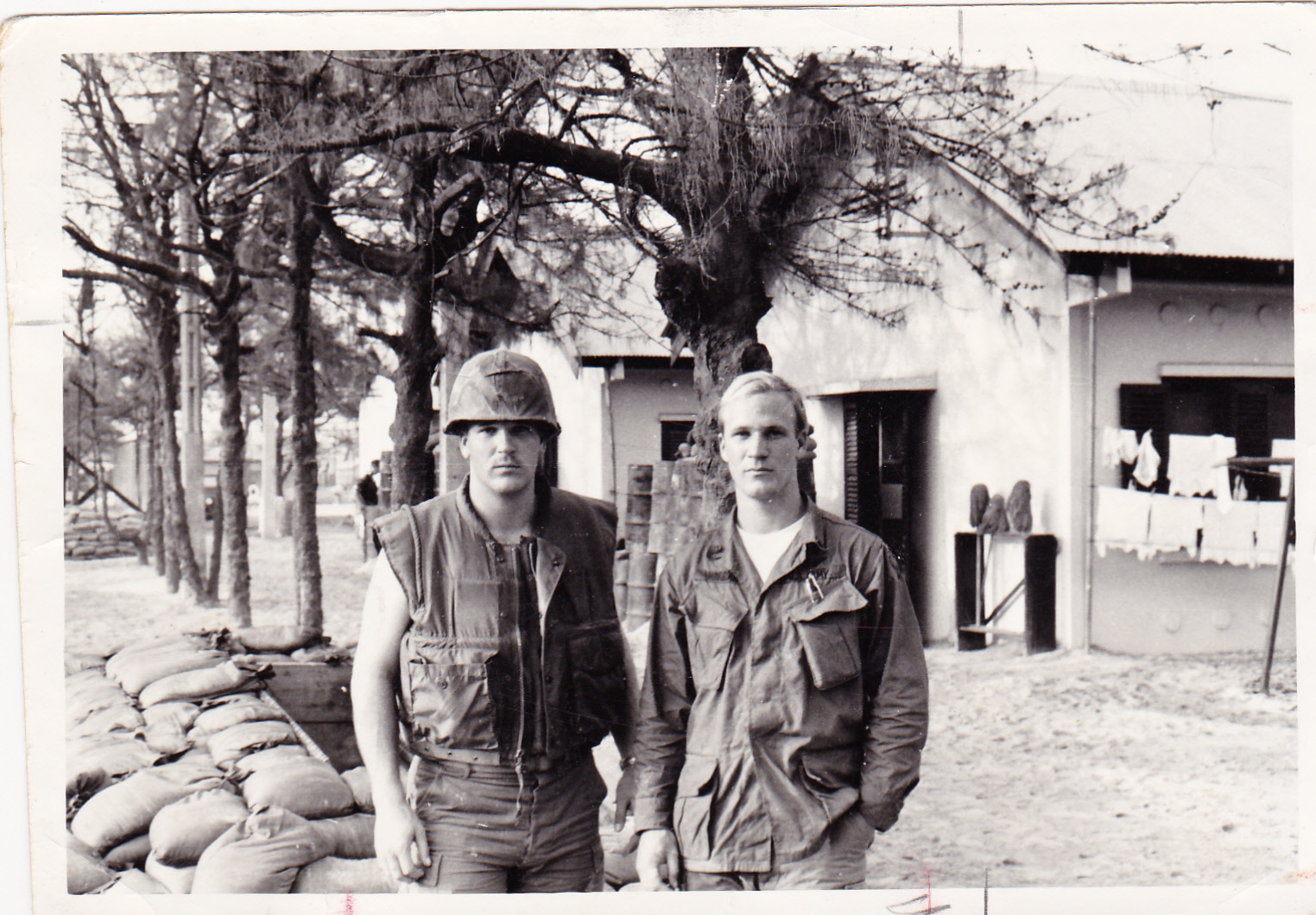
This is the photo taken by an unknown photographer of Sp/5 John P. Selberg US Army (right) and Corporal Edward Michael Selberg USMC (left) in DaNang. [Dated 1967]
Were you drafted or did you enlist?
He volunteered. “Did one tour, lasted about a year. Sometimes tours were longer, it just depended on what was needed for the troops.” John was 18 y.o. when he entered the service. His older brother Michael was also 18 when he enlisted.
When I asked about how it was to serve in the field with men who were drafted – did that make a difference?
“Volunteers vs. drafted didn’t make a lot of difference in the field occasionally it would but by and large I didn’t see much of a difference — when you’re fighting for your life, you’re fighting for your life.”
What was your duty on the Huey?
“I was a helicopter crew chief… a Senior crew chief.”
John served in the US Army’s 176th Assault Helicopter Company in 1968-69.
Asked him how many men would be on a crew for the chopper.
“There are four men on a Huey — the aircraft commander; the ‘fear pilot’ a.k.a co-pilot who is new in country; a crew chief and a door gunner.” Besides the combat duties, he mentioned they also picked up wounded as a MEDEVAC.
With his mention of picking up wounded, I told him my dad was a First Lieutenant in the Army in WWII. His duties included being the GRO* officer for his unit – 78th Division, 311th Infantry. He never talked about battle. Occasionally, he shared stories about organizing boxing matches for the men. He never mentioned his Bronze Star he received for the GRO work. (*Graves Registration Officer)
After telling John my Dad’s story — he remarked, “Being in the military was his job — I remember going out to areas to pick up the bodies of the killed soldiers, it’s tough to see. That’s what war is about Maureen those brave people. And your dad took care of them.”
During the war did you write letters home or make cassettes?
“No didn’t have cassettes. I wrote letters to my mom, told her everything’s fine, that’s about all.” Adding, “I was very busy so didn’t spend a lot of time writing letters.”
Do you have a best memory from your time in the service?
“The food – I came from a family who didn’t have a lot to eat – three meals a day were my best memory.”
How old were you and Michael when you met in ’Nam during the Tet Offensive?
“It was in late ‘68 or early ‘69 Tet is a big holiday in Vietnam. Our military knew from experience the TET time was also a very active time when the enemy would step up attacks.”
Where in Vietnam did you accidently meet your brother?
“DaNang”
Can you fill me in on how this meeting happened?
“It was the beginning of my brother’s 2nd tour and end of mine. I remember landing on the tarmac and not much more.”
How long were you able to spend together?
“Not really sure, couple of hours at the most.” He couldn’t remember exactly who was coming in and who was going out, but they were both in transition. In trying to remember more, he said, “Michael was stationed in Da Nang since he was in the Marines. I was stationed in Chu Lai (50 miles south of Da Nang).” John’s crew would be assigned sometimes to work in different places, and stay a while. Da Nang was one of those areas. The crew would stay a few days and work for whomever or whatever needed to be done.
What type of work?
“Resupplying MEDEVACS, search and extractions – where we would pick people up from around the place, mostly Americans and soldiers. Americans did the majority of the fighting there but other countries had troops fighting and would also need to be picked up and dropped off to their jobs. Occasionally the Vietnamese would be taken out and they weren’t as eager or as willing to go out.” He paused and stated, “War doesn’t change a whole lot — Vietnam was a lot like what we’re doing today – training local people to fight their wars.”
How did your parents handle the repercussions of this war on you, and your family?
“My parents were divorced when he was about 11. We moved up to Santa Barbara when they were in the process of breaking up. My mother is whom we all lived with and she worried of course. My dad didn’t worry about too much…. Dad stayed here for some time, he moved up to Washington State in late 70s.” His mother died in 1971 – shortly after he got out, from a stroke.
Did you and Michael talk to each other about the experiences you went through?
“We both came home to Santa Barbara. Don’t honestly remember…. imagine we did but I don’t have any specific recollection.”
Were your younger brothers privy to conversations you and Michael might have had after coming home?
“No they would not have. For my part, I may have said a few things, but it’s not something we would actively sit down and have a long discussion about with my younger brothers. It would have been Mike, Tom and myself who would have been privy to what’s going on my younger brothers, Jim, Chris and David no.
What did you discover that was starkly different from the training you rec’d at Fort Rucker in Alabama to the reality of combat?
There was no pause for his answer. “Well, yeah, people shot back at you. We did have a few helicopter crashes – I don’t remember how many but everything from mechanical to other issues brought us down.”
Did you while in combat, ever find yourself pushing your helicopter past what its limits were according to your training?
“Yes all the time.” I pressed for details. “We would of course do more than we were allowed – always did more time in the air. A lot of folks went above and beyond – everybody did – he did as well – he did his job.”
Did you go ever fly into Cambodia or Laos?
“Probably. This was a very political and messy war. The US was in Laos and Cambodia just like the North Vietnamese. The enemy had a main supply line thru Laos and Cambodia where lines of troops and vehicles would use that road – we called it Highway 1. Coming out of North Vietnam and China, through Laos. It was this very tough, nasty, bumpy road and a lot of troops came into Vietnam by it. People were shot down, they needed to be rescued… didn’t matter where they were, we went in.” John took a moment before saying, “A lot of brave men and women – saw a lot of them in the back of my helicopter – died there. Regardless of the politics — those were people who I love and admire for all my days – even if I didn’t know them. Regardless of politics – people are people.”
Asked about the medals he was awarded – to get an accurate count. Is it true you rec’d seven Purple Hearts?
“Nope, that’s not correct. I don’t discuss my medals for one reason — anything I’ve got absolutely pales in comparison to what those folks gave on the Wall. He just did his job, regardless of what the military gave me. Those folks he had in the back of his helicopter gave their all.” He mentioned the Santa Barbara News Press had an article about them meeting in Vietnam since it was so coincidental. Adding, “It wasn’t completely accurate. I had no input into that story.” He again put the men whose names are on the Wall as being front and center. “I just feel the focus should be simply, I served and I hold in VERY high regard the full measure those folks gave listed on that Wall.”
As a civilian, I wanted to ask you, of the movies that have been made about that war – – do any of them really reflect what happened to you?
“Avoided them for many, many, many years. I’ve seen parts of some — some do and some don’t – depended on your job. They’re a mix of real, Hollywood and politics. Partial truths. In any war the government only feeds what they want to feed you — at home.”
Did you see ‘Saving Private Ryan’ (in ’99)?
“Yes I did, the year after it came out. WWII was a different war — WWII vets are to be admired. We in Vietnam, we didn’t score beaches with hostile fire. The kind where you’d see thousands of your comrades dead on the beach — those scenes were intense. I think those who have been in combat can say ‘I understand how you feel’…its intensity.”
He continued, “Folks who were in WWII they are the greatest generation. (They) got us through the depression and WWII, which was just massive – they were quite a generation.”
Talk about the less than welcoming reception you and other Vietnam Veterans received. Has that memory lessened over the years or does it still persist?
“People who resisted me – in airports, and I did get spit on – that was then.” Going into staccato phrases, “…politics …unpopular war …tough going thru all the major airports. Anyone wanting the cheaper ticket had to wear the uniform to get standby. We were under orders to stay in uniform in the airports…to get home, or going to or from an assignment of duty, or on leave.”
He continued, “The pilots and crews were great. We learned once we got on the airplane to take the uniform off and get into civilian clothes.”
Peggy stepped in and said “We don’t do the same thing to returning vets now. We learned our lesson from Vietnam.”
“As Peg said, we learned our lesson. Whether you are for or against the war. We’re individuals.”
Have you ever been welcomed home? Does it mean something now when people say welcome home to you?
“I never heard anyone say to me welcome home but I have been told this in the last year. I went to Lowe’s, because you get a discount as a veteran and all I have to do is show my VA card. At checkout, the cashier said to me, ‘thank you for your service’ and I didn’t know how the hell to respond. First time in 50 years! Over the last couple of years I’ve had to go to the VA for things – they’d automatically say it. Never had anyone outside the military thank me for my service.”
John said he makes a point of going up to guys in the military to thank them for their service.
What did you do with your uniform? Did you ever want to see it again?
An emphatic no came back. Said he put it away and it got misplaced for decades. Somehow the dress uniform showed up again. He hasn’t to this day taken it out – it’s still covered up.
Peggy said laughing, “He darn sure couldn’t get into now! John added, “Need some parachute canvas to expand to fit me.”
Sensing we were coming to the end, and the mood had lightened a bit, I asked John if he had any anecdotes he could recount. Our VVA president, Peter Bie suggested I might jolt a memory by bringing up the red tie downs on the Huey blades that read ‘Remove Before Starting.’ It worked.
He immediately came back saying, “Oh yeah, tie downs. We had some engine mechanics in one of the gun ships. They had installed the engine and went out to test it. The start up procedure list is long. You only have to go through a few as a mechanic to see if fuel was running properly, but these guys thought they’d go ahead and crank that puppy up. They weren’t supposed to do that. Both of them were in the bird and they left the blade tie-downs on.” John was a couple 100 yards away when he heard it crank up. “All the power that engine brings up, well, it threw the copter on its side with them in it. They were court-martialed, got demoted and opted to stay in the military for decades. Their salaries were docked to pay for the damages.”
What did you do when you got home?
“When I got home I worked in aerospace lines. I left Santa Barbara in ’72 or ’73 to go to school on the GI Bill.” Once he graduated, he went to work. He never came back to Santa Barbara to live, only to visit. He’s lived in Oregon, Washington, Idaho and now New Mexico. He admitted, it was his 3 y.o. Grandson Riley brought them to Albuquerque. John’s son is a fireman and his wife is a schoolteacher.
Thanked he and Peggy for their time. Mentioned how good a partner she is to him.
“Yeah, Peggy keeps me towing the line.”
-30-
Maureen ‘Mo’ McFadden has been the press agent for the local Vietnam Veterans of America Chapter 218 since 2011. Her PR firm is located in Santa Barbara.
http://www.McFaddenpr.com and on Facebook https://www.facebook.com/MnMPR/
 tellmemo